Burns Lab at NAOC in DC

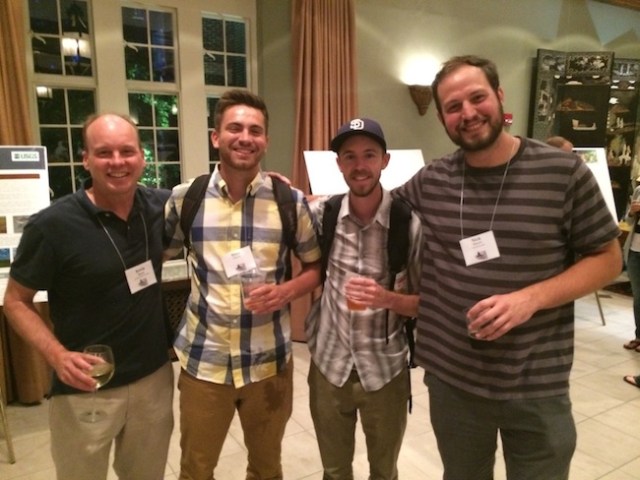
The Burns lab recently traveled to D.C. to attend the North American Ornithological Conference, which was the largest gathering of professional ornithologists in history. Eight past and present Burns lab members were in attendance. Erik received an AOU travel award to present his talk on conservation indices of tanagers. Brian also received a travel award to present his hummingbird hybrid zone results. We were joined by Amelia who was winding up her data collection of tanager morphology at the Smithsonian. We were also able to reconnect with former Burns lab students Shannon (Walsh) Mindeman, Nick Mason, Allison Shultz, and Bill Mauck. In total, nine presentations were authored by Burns lab members past and present. Attending the meeting was a great way to cap off a busy summer for the Burns lab!

BurnsLabNAOC

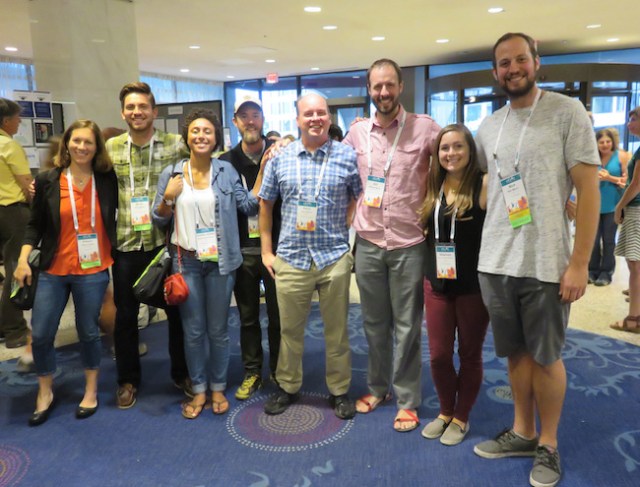
Burns lab past and present at NAOC VI, from left to right: Allison Shultz, Brian Myers, Amelia Demery, Erik Funk, Kevin Burns, Bill Mauck, Shannon Mindeman, and Nick Mason

Posted in Uncategorized | Comments Off on Burns Lab at NAOC in DC

2016 NAOC in DC

Burns lab members past and present will be well represented at the upcoming North American Ornithological Conference in Washington, DC. Here is a list of presentations by both former and current Burns lab members (in bold):

Wednesday, 1:45 pm, Room 8 Georgetown West
Using phylogenetic distinctiveness to prioritize species conservation in the largest family of songbirds (Thraupidae) Funk, Erik – San Diego State University; Kevin Burns – San Diego State University

Thursday, 5:30-7:00 pm, Poster Session D, Poster 94
Applications of behavioral and morphological data across a hummingbird hybrid zone Myers, Brian – San Diego State University; Christopher Clark – University of California, Riverside; Kevin Burns – San Diego State University

Thursday, 5:30 pm, General Lightning Session D, Room 11 Gunston West
Genetic and behavioral divergence among Northern Cardinal populations: testing the permeability of a biogeographic barrier Provost, Kaiya – Columbia University/American Museum of Natural History; William Mauck – American Museum of Natural History; Brian Smith – American Museum of Natural History

Thursday, 5:50 pm, General Lightning Session D, Room 11 Gunston West
Asymmetric gene flow during the protracted diversification of dry-forest- bird assemblages in northwest Peru Oswald, Jessica – Louisiana State University; Isaac Overcast – City College of New York; William Mauck – American Museum of Natural History; Michael Andersen – University of New Mexico; Brian Smith – American Museum of Natural History

Thursday, 6:05 pm, General Lightning Session D, Room 11 Gunston West
Endemism in the Pacific lowlands of Mexico: Phylogeography of the White- collared Seedeater (Sporophila torqueola) Mason, Nicholas – Cornell University; Arturo Olvera-Vital – Universidad Nacional Autonoma de Mexico; Adolfo Navarro- Sigüenza – Universidad Nacional Autónoma de México

Thursday, 6:45 pm, General Lightning Session D, Room 12 Cardozo
Phylogenomics of Lories and Lorikeets (Order: Psittaciformes) Mauck, William – American Museum of Natural History; Michael Andersen – University of New Mexico; Brett Benz – American Museum of Natural History; Brian Smith – American Museum of Natural History

Friday, 4:30 pm, Room 14 Cabinet
Molecular phylogeny and biogeography of kingfishers (Alcedinidae) Andersen, Michael – University of New Mexico; Jenna McCullough – University of New Mexico; William Mauck III – American Museum of Natural History; Brian Smith – American Museum of Natural History; Robert Moyle – University of Kansas

Saturday, 11:30 am, Room 13 Fairchild East/West
Evolution of the Innate Immune System Across the Bird Tree of Life Shultz, Allison J. – Harvard University;  Julia Yu – Harvard University; Tim Sackton – Harvard University

Saturday, 11:45 am, Room 6 Lincoln West
Phylogeography and geographic variation in the Red-bellied Woodpecker (Melanerpes carolinus) Barrowclough, George – American Museum of Natural History; Jeff Groth – American Museum of Natural History; Elizabeth Bramlett – American Museum of Natural History; William Mauck – American Museum of Natural History; Jonas Lai – American Museum of Natural History

Posted in Uncategorized | Comments Off on 2016 NAOC in DC

Bell’s Vireo Conservation Genetics

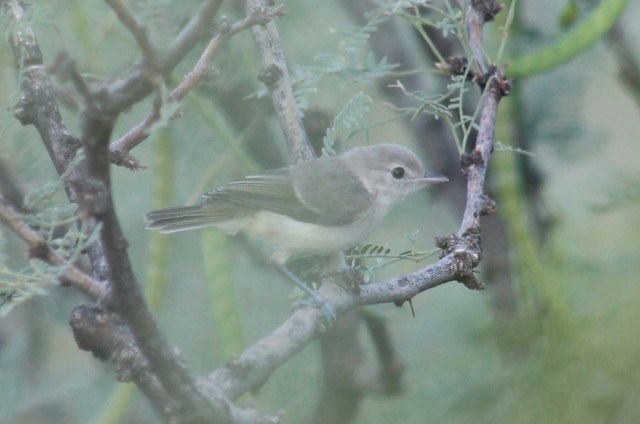
Congrats to Luke Klicka who just published his MS thesis in Conservation Genetics. Luke studied genetic variation in the Bell’s Vireo across its range using both mtDNA sequences and a genome-wide analysis of SNP data. In the paper, he provides evidence that there are two distinct species of Bell’s Vireo, one in the eastern part of the range and one in the western part of the range. In addition, the samples of Least Bell’s Vireo subspecies included in the study were genetically distinct and formed their own clade. Thus, his paper provides the first evidence that this endangered subspecies is genetically distinct from other Bell’s Vireos. Collaborators on the project include Barbara Kus, who has worked with the Least Bell’s Vireo for years, and former Burns lab student Pascal Title, who added a niche modeling element to the paper.

Klicka, L. B.*, B. E. Kus, P. T. Title*, and K. J. Burns. in press. Conservation Genomics reveals multiple evolutionary units within Bell’s Vireo (Vireo bellii). Conservation Genetics. pdf

Bell's Vireo

Bell’s Vireo, Elephant Mountain, Texas, photo by S. Walsh

Posted in Uncategorized | Comments Off on Bell’s Vireo Conservation Genetics

Welcome Amelia!

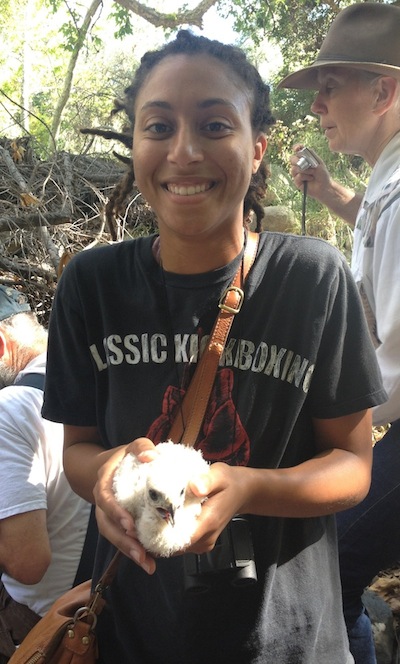
The Burns lab welcomes new MS student Amelia Demery this semester. She received her BS in Biology (emphasis: Zoology) from California Polytechnic State University in Pomona. At Cal Poly, Amelia participated in a variety of teaching, research, and outreach activities. For her thesis, Amelia is working on morphological evolution in tanagers. Welcome Amelia!

Amelia Demery

Posted in Uncategorized | Comments Off on Welcome Amelia!

Summer Meetings

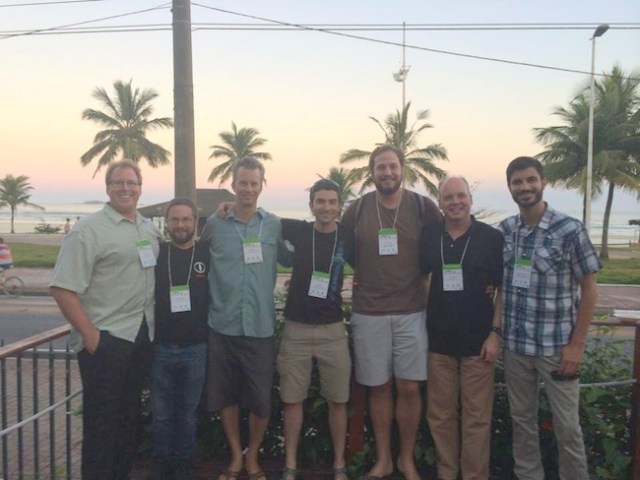
Members of the Burns lab participated in a couple professional meetings this summer. Kevin Burns and former Burns lab students Nick Mason and Pascal Title attended the Evolution meetings in Guarujá, Brazil in June. Kevin presented a summary of the lab’s work on tanagers and Nick presented a talk looking at vocal evolution in tanagers and woodcreepers. Both Nick and Kevin, as well as current Burns lab members Erik Funk and Bryan Myers, attended the joint meeting of American Ornithologists’ Union and the Cooper Society in Norman, Oklahoma. Lots of good science at both meetings as well as good birds. Bird highlights of the Brazil meetings included Green-headed Tanager, and bird highlights of the Oklahoma meeting include Black-capped Vireo and Painted Bunting.

MasonTitleBurns

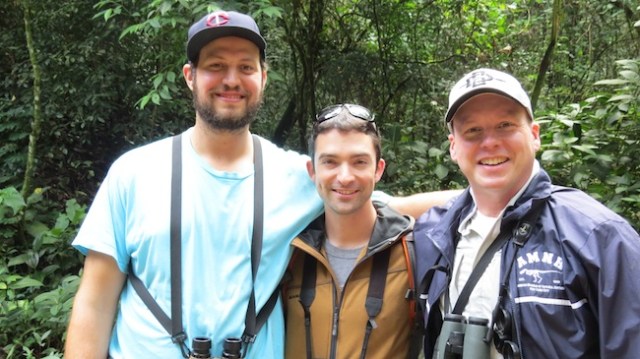
birding in the Atlantic Forest of Brazil; Nick Mason, Pascal Title, Kevin Burns

EvolutionMeetings

SDSU students past and present at the Evolution meetings in Guarujá, Brazil

AOUMeetingsOklahoma

Kevin Burns, Brian Myers, Erik Funk, and Nick Mason at the AOU/COS bird meetings in Norman, Oklahoma

Posted in Uncategorized | Comments Off on Summer Meetings

Congratulations Brian!

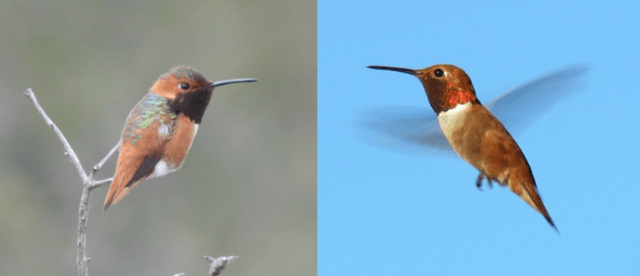
Brian Myers has received two grants to help fund his research on Rufous and Allen’s Hummingbirds. Brian is studying genetic divergence across these species. In particular, he is interested in the interplay of genetics and behavior across a hybrid zone between the two species. Brian is conducting this research in collaboration with Chris Clark at UC Riverside. We thank the American Museum of Natural History (Frank M. Chapman Award) and the Los Angeles Audubon Society (Ralph W. Schreiber Award) for helping fund this work.
AllensRufousHummingbirds

Allen’s and Rufous Hummingbirds

Posted in Uncategorized | Comments Off on Congratulations Brian!

Shannon successfully defends thesis!

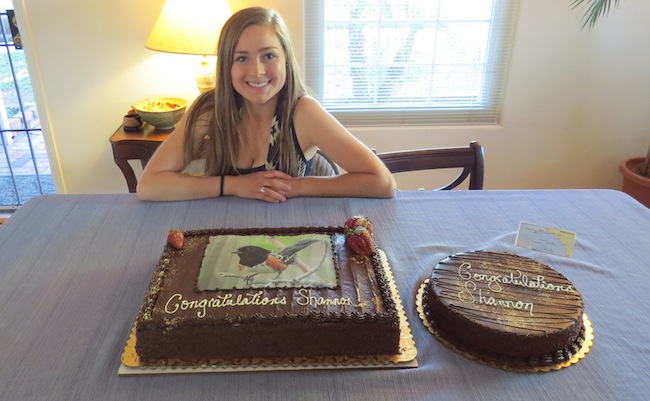
Congratulations to Shannon Walsh who successfully defended her MS thesis on the Spotted Towhee of California’s Channel Islands. Shannon studied the genetics of the Spotted Towhee on the Channel Islands, comparing genetic diversity among the islands as well as comparing island populations to those on the nearby mainland. Shannon has now started a career in biological consulting and we wish her the best of luck!

Shannon Walsh

Posted in Uncategorized | Comments Off on Shannon successfully defends thesis!

New paper on tanager song and habitat

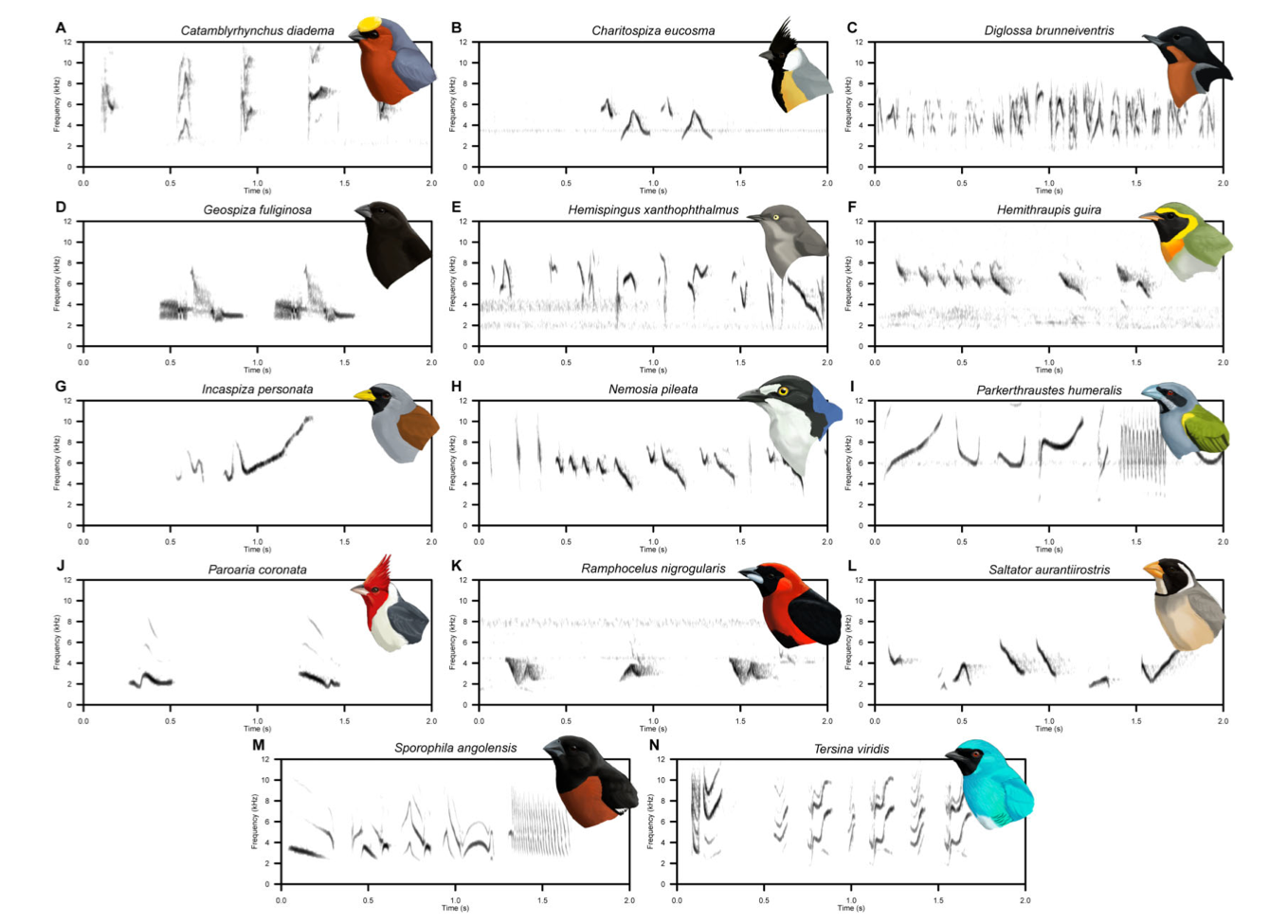
Nick Mason recently published part of his MS thesis in the Biological Journal of the Linnean Society on tanager song and habitat. In this paper, Nick looked for correlations between body size, habitat, and vocal characteristics across the evolutionary tree of tanagers. In particular, Nick was interested in testing ‘the acoustic adaptation hypothesis’ which says differences in vegetation structure impose different selective pressures on song evolution. For example, birds that sing in more closed habitats should have lower vocal frequencies. Since tanagers are the largest family of songbirds, they would be a good place to look for such correlations. However, Nick found that habitat was only correlated with a few song characters. Instead, body size plays a more important role in shaping the evolution of song differences among species. Nice paper Nick!  Here is the full citation:

Mason, N.A.* and K. J. Burns. 2015. The effect of habitat and body size on the evolution of vocal displays in Thraupidae (tanagers), the largest family of songbirds. Biological Journal of the Linnean Society 114: 538–551. For pdf, you can go to the journal’s web site or just send an email request to kburns@mail.sdsu.edu.

TanagerSongs

Variation in tanager song. Tanagers are often assumed to be poor singers, but they actually produce a variety of vocalizations. Thanks Mary Margaret Ferraro for the great illustrations!

Posted in Uncategorized | Comments Off on New paper on tanager song and habitat

Burns lab research featured on Cornell site

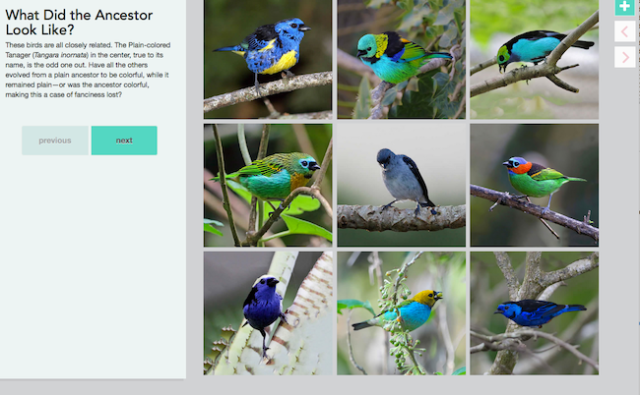
Cornell’s Lab of Ornithology has highlighted some of our lab’s research on their new interactive web site “All About Fancy Males”. This is part of their “All About Bird Biology” series. The data featured was part of Allison Shultz’s MS thesis and was used  in a study done by graduate students Nick Mason and Allison Shultz that was published last year (Mason et al. 2014). It’s a pretty fun little game – click here or the picture below to play “Fanciness Lost”.

Fanciness Lost

Posted in Uncategorized | Comments Off on Burns lab research featured on Cornell site

2014 Biosymposium

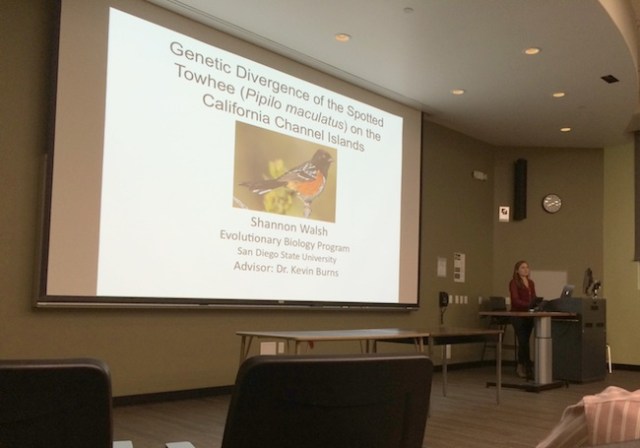
Burns lab graduate student Shannon Walsh was one of three graduate students asked to speak at this year’s Biology Department Symposium. She presented some of her work on genetic divergence in the Spotted Towhee on the Channel Islands, located off the coast of southern California. This is part of her MS thesis which she will be wrapping up next semester. Great talk Shannon!

Shannon Walsh

Posted in Uncategorized | Comments Off on 2014 Biosymposium