New paper on the origin of finches on Tristan da Cunha and Gough Island

We published a paper in this month’s Molecular Phylogenetics and Evolution on the relationships of some finch-billed tanagers in the genera Nesospiza and Rowettia. These four tanagers are unusual in that they are the only tanagers found outside of the Americas, occurring on Gough Island and the Tristan da Cunha archipelago in the South Atlantic. These are some of the most remote islands in the word and are about halfway between South America and Africa. Remarkably, the topology of our trees indicates that there were two colonization events to these islands; the Gough Island Finch (the sole member of the genus Rowettia) is not the sister species to the Nesospiza finches. This project represents a collaboration with colleagues Peter Ryan and Keith Barker and was a side project of Burns lab MS student Luke Klicka. If you would like a pdf, you can go to journal’s web site or just send an e-mail to kburns@mail.sdsu.edu.

RyanetalGraphicalAbstract

Species tree generated in *BEAST showing relationships of Nesospiza and Rowettia to South American tanagers. Posterior probabilities are given at each node. The island species are not each other’s closest relatives.

Posted in Uncategorized | Comments Off on New paper on the origin of finches on Tristan da Cunha and Gough Island

2013 AOU/COS Meetings

The Burns lab recently traveled to Chicago to attend the annual meeting of the American Ornithologists’ Union and the Cooper Ornithological Society. Kevin presented a talk co-authored with former students Allison Shultz, Pascal Title, and Nick Mason summarizing their work on tanager diversification. Luke Klicka received a student travel award to present his results on Bell’s Vireo phylogeography and conservation genetics. There were lots of great talks at the meeting, including a symposium on new and exciting methods in collections-based research. Former Burns lab student Nick Mason presented some results from his MS thesis during this symposium. In addition, former Burns lab student Allison Shultz won a presentation award for her work on House Finches that she is undertaking for her PhD at Harvard. In total, seven past and present Burns lab students were at the meetings this year.

BurnsLab

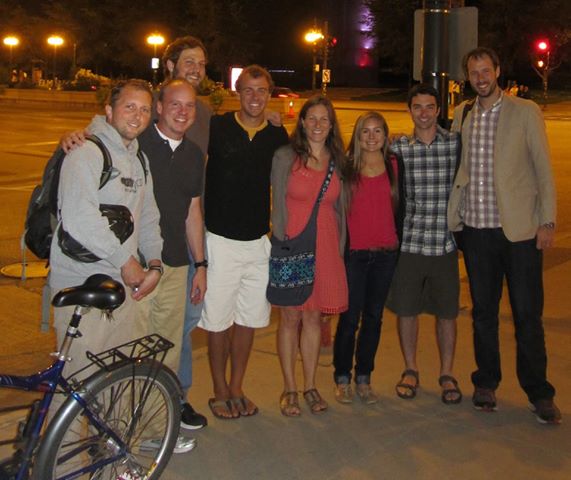
Burns lab past and present at AOU/COS meetings, from left to right: Erik Sgariglia, Kevin Burns, Nick Mason, Luke Klicka, Allison Shultz, Shannon Walsh, Pascal Title, Bill Mauck


Posted in Uncategorized | Comments Off on 2013 AOU/COS Meetings

Upcoming AOU/COS meeting in Chicago

Lots of Burns lab members past and present will be represented at the upcoming joint meeting of the American Ornithologists’ Union and Cooper Ornithological Society in Chicago. Here is a full list of presentations authored or co-authored by past or present Burns lab members*. Looking forward to seeing everyone!

Wednesday, 14 August 2013
Symposium 1. Grand Ballroom. The assembly of the North American avifauna.
s1.8 14:30 The temporal and spatial dynamics of speciation during the New World nine-primaried oscine radiation. DANIEL RABOSKY, Dept. Ecol. & Evol., Univ. Michigan, Ann Arbor, MI, B. M. WINGER, Committee Evol. Biol., Univ. Chicago, Chicago, IL, I. J. LOVETTE, Lab. Ornithol., Cornell Univ., Ithaca, NY, F. K. BARKER, Dept. Ecol., Evol. & Behav., Univ. Minnesota, St Paul, MN, K. J. BURNS*, Dept. Biol., San Diego State Univ., San Diego, CA, J. KLICKA, Dept. Biol., Univ. Washington, Seattle, WA, and S. M. LANYON, Dept. Ecol., Evol. & Behav., Univ. Minnesota.

Session 3A. Wabash Room. Systematics
54 16:45  Phylogeography and signatures of pathogen-mediated selection using genome-wide diachronic comparisons in the House Finch (Haemorhous mexicanus).
ALLISON J. SHULTZ*, Dept. Organ. Evol. Biol., Mus. Comp. Zool., Harvard Univ., Cambridge, MA, ALLAN J. BAKER, Dept. Nat. Hist, Royal Ontario Mus., Dept. Ecol. Evol. Biol., Univ. Toronto, Toronto, ON, GEOFF E. HILL, Dept. Biol. Sci., Auburn Univ., Auburn, AL, PAUL M. NOLAN, Dept. Biol., The Citadel, Charleston, SC, and SCOTT V. EDWARDS, Dept. Organ. Evol. Biol., Mus. Comp. Zool., Harvard Univ.

Thursday, 15 August
Poster Session
390 Origin and biogeographic history of the family Trogonidae. WILLIAM M MAUCK III*, JOEL L. CRACRAFT, Dept. Ornithol., Am. Mus. Nat. Hist., New York, NY, PETER HOSNER and ROBERT G. MOYLE, Dept. Ecol. & Evol. Biol. and Biodiversity Inst., Univ. Kansas, Lawrence, KS.

Friday, 16 August 2013
Session 7C. Chicago Room. Systematics
139 10:30 Diversification of tanagers (Thraupidae), the largest radiation of Neotropical songbirds. KEVIN J. BURNS*, ALLISON J. SHULTZ*, PASCAL O. TITLE* and NICHOLAS A. MASON*, Dept. Biol., San Diego State Univ., San Diego, CA.

Session 8B. Crystal Room. Systematics
151 13:30 Phylogeography and conservation genetics in the morphologically variable Bell’s Vireo. LUKE B. KLICKA*, KEVIN J. BURNS*, Dept. Biol., San Diego State Univ., San Diego, CA, and BARBARA E. KUS, US Geol. Surv., Western Ecol. Res. Center, San Diego, CA.

Saturday, 17 August 2013
Symposium 10. Grand Ballroom. The extended specimen: emerging frontiers in collections-based ornithological research.
s10.5 10:30 Combining museum and media collections to study multimodal sexual signaling and acoustic adaptations in tanagers (Thraupidae). NICHOLAS A. MASON*, KEVIN J. BURNS*, Dept. Biol., San Diego State Univ., San Diego, CA, and ALLISON J. SHULTZ*, Dept. Organ. Evol. Biol., Harvard Univ., Cambridge, MA.

Posted in Uncategorized | Comments Off on Upcoming AOU/COS meeting in Chicago

New tanager account published

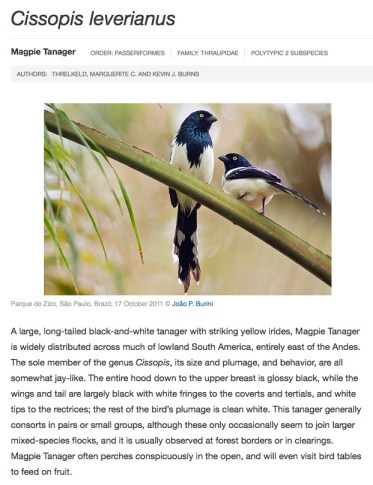
Burns lab undergraduate student Cate Threlkeld just published an account of the Magpie Tanager for Neotropical Birds Online, produced by Cornell University’s Lab of Ornithology. Below is an image of the first page of the account, click it to read the full account. Links to other tanager accounts published by Burns lab members can be found on our publications page. Cate was an undergraduate researcher in the Burns lab for six semesters and worked on a variety of projects from studying tanager vocalizations to helping with our museum collection. She also just graduated with her BS in Biology; we miss her and thank her for all her help!

Magpie Tanager (Cissopis leverianus)


This is the first page of the Magpie Tanager account, click the image to read the full account

Posted in Uncategorized | Comments Off on New tanager account published

Congratulations Shannon!

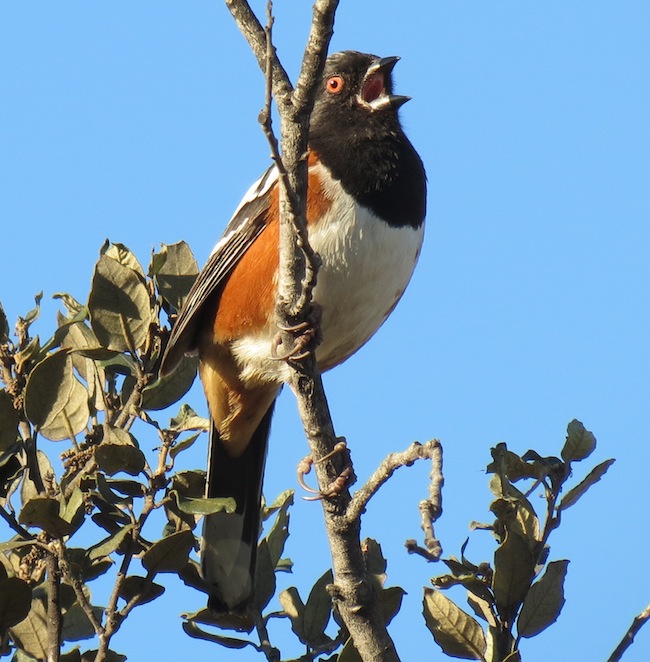
Burns lab graduate student Shannon Walsh recently received a Frank M. Chapman Award from the American Museum of Natural History to help fund her project investigating the conservation genetics of the Spotted Towhee (Pipilo  maculatus) on California’s Channel Islands. Two subspecies of the towhee occur on the Channel Islands, the mainland subspecies and an island endemic subspecies. Using DNA sequence data, she is studying the evolutionary history of the towhees on the islands and evaluating their genetic distinctiveness. The island endemic subspecies, P. m. clementae, is classified as a California species of conservation concern.

Spotted Towhee (Pipilo maculatus)

Spotted Towhee (Pipilo maculatus), Mission Trails Regional Park, San Diego

Posted in Uncategorized | Comments Off on Congratulations Shannon!

New Paper on the cover of Systematic Biology

Barker, F. K., K. J. Burns, J. Klicka, S. M. Lanyon, and I. J. Lovette. 2013. Going to extremes: Contrasting rates of diversification in a recent radiation of New World passerine birds. Systematic Biology 62: 298-320. link to article

On the cover of this month’s issue of Systematic Biology is an article by Keith Barker, John Klicka, Scott Lanyon, Irby Lovette, and myself on the radiation of New World nine-primaries oscine birds. This group of birds is huge, containing about 8% of all bird species. About half of the birds are tanagers, birds that we have been studying in the Burns lab for years. The other birds in the group are familiar to North American birders and include blackbirds, sparrows, warblers, grosbeaks, and cardinals. The paper represents our first comprehensive look at the phylogeny of these birds, which we have been working on collectively for over 10 years. One of the more interesting findings is that the rate of speciation in tanagers has been significantly higher than that of other groups, with a rate of diversification similar to that of Hawaiian silverswords.  Taxonomically, we suggest some major changes at the family level. To preserve the 5 existing, familiar families, we had to add 11 other families. For example, the Yellow-breasted Chat now has its own family as well as some radiations unique to islands in the Caribbean. The cover looks pretty cool, with 13 of the 16 families represented by a photo. If you like this paper, stay tuned as we have several more in the works!

March2013SystematicBiology

Posted in Uncategorized | Comments Off on New Paper on the cover of Systematic Biology

New paper published on color evolution and relationships in a large clade of tanagers

Shultz, A. J. and K. J. Burns. 2013. Plumage evolution in relation to light environment in a novel clade of Neotropical tanagers. Molecular Phylogenetics and Evolution 66: 112-125.

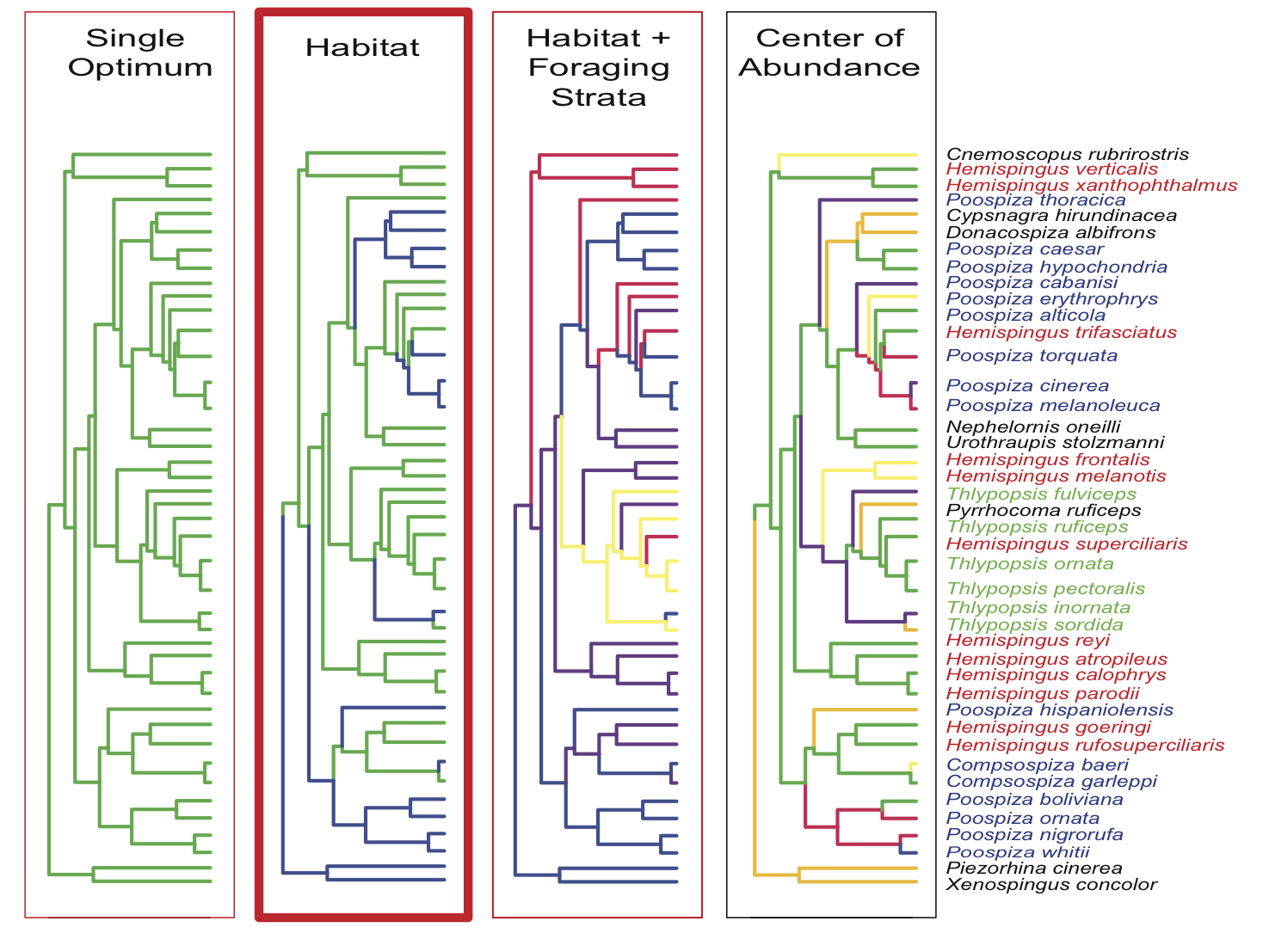
We recently published a paper in Molecular Phylogenetics and Evolution on plumage evolution in one of the many clades of tanagers. This paper represents a side project of Allison Shultz’s thesis. In the paper, we describe a novel clade of tanagers that includes Hemispingus, Poospiza, Thlypopsis, and nine other genera. A variety of species are included in the group, some of which were traditionally considering tanagers and some of which were traditionally considered finches. Among the species in the group is the Pardusco, Nephelornis oneilli. The clade is illustrative of the taxonomic mess of tanagers as many of these genera are not monophyletic in our analyses. In addition to describing relationships of these species, the paper also looks at how light environment shaped plumage evolution in the group. We found that evolution of brightness follows expectations for selection based on crypsis and that more colorful plumage is found in closed in environments than in open environments. For a pdf, you can go to journal’s web site or just send an e-mail to kburns@mail.sdsu.edu. If you like this paper, there will be more to come as Allison is currently writing up her thesis papers on plumage evolution in all 370 birds that we now consider to be tanagers.

PooHemiGraphicalAbstractJune62012

Of four models of plumage evolution, one including open vs. closed habitats (highlighted in red) is preferred over the others. Species names on the left are color-coded by genera to illustrate widespread paraphyly within this clade of tanagers.


Posted in Uncategorized | Comments Off on New paper published on color evolution and relationships in a large clade of tanagers

New paper published on beak development in Darwin’s Finch relatives

Mallarino, R., O. Campàs, J. A. Fritz, K. J. Burns, O. G. Weeks, M. P. Brenner, and A. Abzhanov. 2012. Closely related bird species demonstrate flexibility between beak morphology and underlying developmental programs. Proceedings of the National Academy of Sciences 109: 16222-16227. pdf

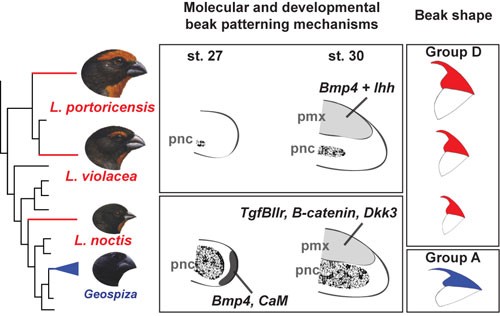
Together with co-authors at Harvard University, we recently published a paper in Proceedings of the National Academy of Sciences that described the evolution of beak developmental pathways in Darwin’s Fiches and their relatives. The paper includes three components: 1) a mathematical analyses of beak shape among the all species in the Tholospiza clade, 2) studies of beak development of Caribbean bullfinches in the genus Loxigilla, and 3) a new phylogeny of Darwin’s Finch relatives based on multiple genes. One of our more interesting findings is that species of Caribbean bullfinches have convergently evolved the exact same beak shape. Unexpectedly, this shape is controlled by different developmental pathways.

Here are links to a couple articles that describe our paper: Science Daily & Harvard Gazette

All three species of Loxigilla (in red) have the same beak shape. However L. noctis is more closely related to Darwin’s finches (Geospiza) than it is to other Loxigilla. Thus, this beak shape has evolved at least twice. In agreement with phylogeny, Loxigilla noctis shares the same beak developmental pathway as Geospiza.
Posted in Uncategorized | Comments Off on New paper published on beak development in Darwin’s Finch relatives

Welcome Shannon!

The Burns lab welcomes new MS student Shannon Walsh this semester. She received her B.S. in Biology from the University of Minnesota. Shannon spent two field seasons working with Burrowing Owls for the USFWS in Oregon and Washington. At the University of Minnesota, she also worked in the Bell Museum and genetics lab of Bob Zink. Shannon is currently exploring project ideas, but is interested in avian conservation genetics.

Shannon Walsh

Posted in Uncategorized | Comments Off on Welcome Shannon!

Least Bell’s Vireo fieldwork

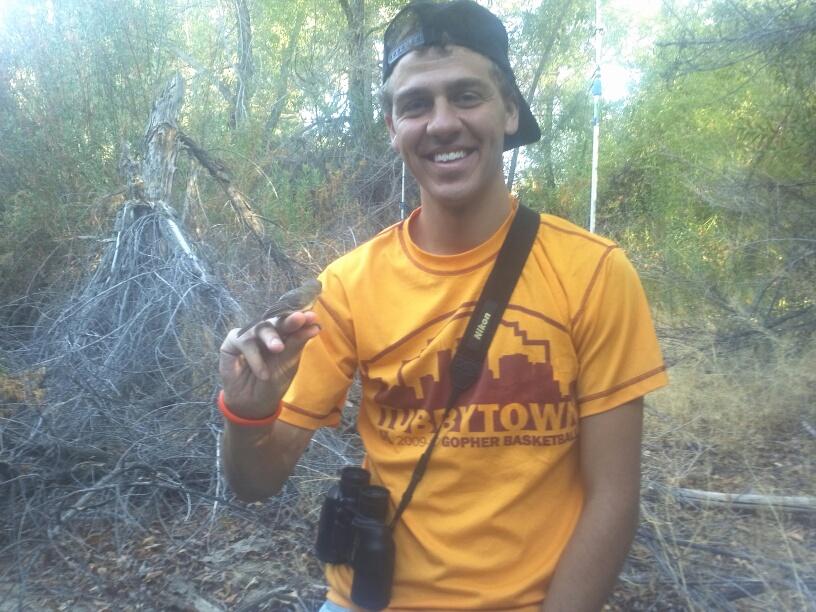
Luke spent part of spring/summer mist netting birds and also sampling Bell’s Vireos for his project on conservation genetics of Least Bell’s Vireo. This year, his efforts concentrated on the Arizona/California border which is a putative contact zone between Least Bell’s Vireo (Vireo bellii pusillus) and the Arizona’s Bell’s Vireo (Vireo bellii arizonae). Now, it’s time to get some genetic data and see what the DNA can tell us. Next field season, Luke plans to sample throughout the range of the species so he can place his findings for the Least Bell’s Vireo in the context of variation seen throughout the entire distribution of the species.

Luke Klicka

Posted in Uncategorized | Comments Off on Least Bell’s Vireo fieldwork